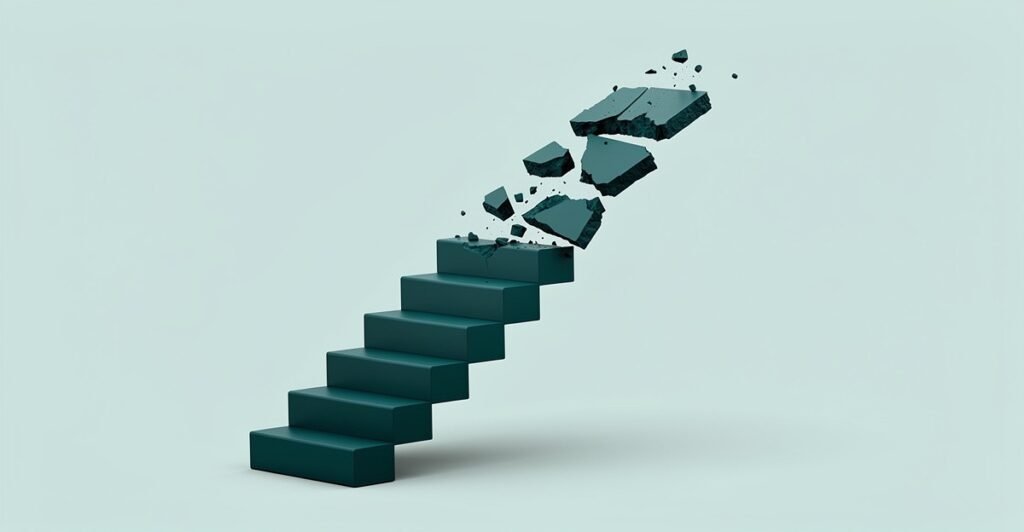
Question to chew on: Is the map that you have drawn for your life reflective of the landscape that you should expect or the one that has been observed?
TLDR: We tend to shape our expectations using the lives of those who came before us, assuming that a similar path will lead to a similar place, but the world has shifted in ways that make that assumption worth questioning. Across health, happiness, relationships, and financial security, outcomes have declined, and for younger generations especially, a more intentional approach to life may matter more than it ever did before.
Consider the vision that you had for your life when you were young, perhaps in your mid-to-late teens. This is roughly the stage of life where we begin to aspire for a degree of independence, and as part of this, we begin to think about what we want for our own lives. What kind of house / apartment do we want? Do we want to get married? Do we want to have children? What kind of job / resources do we want? As we begin to consider these things, we often look at our parents or other members of the preceding generation to develop a sense for what we can realistically expect for ourselves – using their perceived outcomes to calibrate our own aspirations. In some cases, we might seek to emulate them; in other cases, we might resolve to pursue different things.
At first, we might begin this thought process unconsciously, but over time we all become aware of this tendency and begin to use the examples available to us to deliberately gauge what we want for ourselves.
Now, what’s interesting is that we consciously use perceived outcomes to calibrate our expectations, but often we unconsciously assume that we can achieve those same or similar outcomes by taking a similar approach. This is often an assumption that we don’t challenge. For example, if we decide to emulate the outcomes of our parents, we assume that we can follow their approach. If we go to a decent college, get decent grades, not take our career or health too seriously, etc. we can expect that “things will work out” – an assurance many of us heard growing up. We will live in a beautiful home in the suburbs of a metropolitan area with a wonderful marriage, family, etc.
Of course this is a generalization, but many of us unconsciously assume that the haphazard approaches we’ve often inherited will produce the results we’ve come to expect — and that assumption is a problem. The world we’re navigating now is meaningfully different; most of us sense this, though few of us have fully connected the dots.
We hear that housing is less attainable than it has ever been. That student debt is higher. That mental and physical health outcomes are worse. We hear these things, but we don’t always connect these factors back to the expectations that we have developed for our lives and the approach that we have assumed will be effective. The world today presents objectively different, and in many ways more complex, challenges than it did for previous generations.
That last point isn’t meant to diminish what earlier generations faced. It’s simply pointing to the fact that over the last twenty or so years, mental, physical, and economic outcomes have declined on average, suggesting that achieving the outcomes that we have come to expect for ourselves is materially more difficult.
The data, across several measures, tells a consistent story:
Physical Health
Obesity rates have risen sharply across all age groups. Adult obesity climbed from around 30% in 2000 to over 40% today, with severe obesity nearly doubling over the same period. One in five children and teenagers now meets the criteria. The contributing factors are familiar: more sedentary work, more processed food, less time for home cooking. The cumulative effect is a population more prone to chronic illness than any before it.
Mental Health
Depression rates have risen among adults, but the sharpest increases are among young people. Nearly 20% of teenagers report a major depressive episode each year. Suicide rates climbed 30% between 2000 and 2018, and serious psychological distress among young adults jumped over 70% in the decade leading up to 2017. This is no longer a fringe concern. It has become one of the defining public health challenges of our time.
Happiness and Life Satisfaction
The U.S. has slipped steadily in the World Happiness Report, falling from 11th place in 2011 to 24th in 2024, its lowest ranking ever. Older Americans remain relatively content, ranking around 10th globally. Younger generations, however, rank in the 60s, a striking generational gap. The sense of freedom to make meaningful life choices, one of the strongest predictors of wellbeing, has also dropped sharply, one of the steepest declines among wealthy nations.
Relationships and Social Connection
Marriage rates have reached historic lows, with just 47% of households made up of married couples in 2024, down from 55% in 2000 and close to 80% at mid-century. Friendship networks have thinned as well. The share of Americans reporting no close friends has quadrupled since 1990, from 3% to 12%, and nearly half say they have three or fewer close friends. Loneliness, once considered a private struggle, has become a widespread demographic reality.
Economic Security
Median household income has grown just 8 to 9% since 2000 after adjusting for inflation, while home prices have risen over 50%. A typical home cost roughly three times the median income in 2000; today it’s five to six times more. Student debt has tripled since 2006, from around $500 billion to nearly $1.8 trillion. For many young adults, financial insecurity isn’t a passing phase. It’s the baseline.
Conclusions
Now, none of this is meant to suggest that the situation is beyond hope. It’s simply worth acknowledging that if younger generations want to achieve the kinds of outcomes they grew up imagining, they will need to be more intentional about how they approach life than the generations before them had to be.
This is a bitter pill… Accepting that the up-and-coming generations are likely to experience worse life outcomes than the generations that preceded them, on average, is tough. Perhaps I am wrong – I hope I am wrong, but the indicators paint a clear picture; we must either resolve to do better or accept lesser outcomes.
In truth, this is the realization that led me to create this page and to share these thoughts. It is my earnest hope that we can learn to do life better – together.